Precision at every stop.
Better Places geocodes addresses to the actual delivery point. Results are validated across multiple geocoders for a 99% success rate, and, within the Bettermile suite, enriched with a last-meter layer of entrances, parking, and handover locations. That is 15% higher accuracy than standalone geocoding services.
Picture this: a driver receives a half-formatted address with no clear place to stop. Better Places resolves it in a single call.
- Input: you send raw address data (JSON).
- Output: validated geocoordinates and enriched address data, returned to your system (JSON).
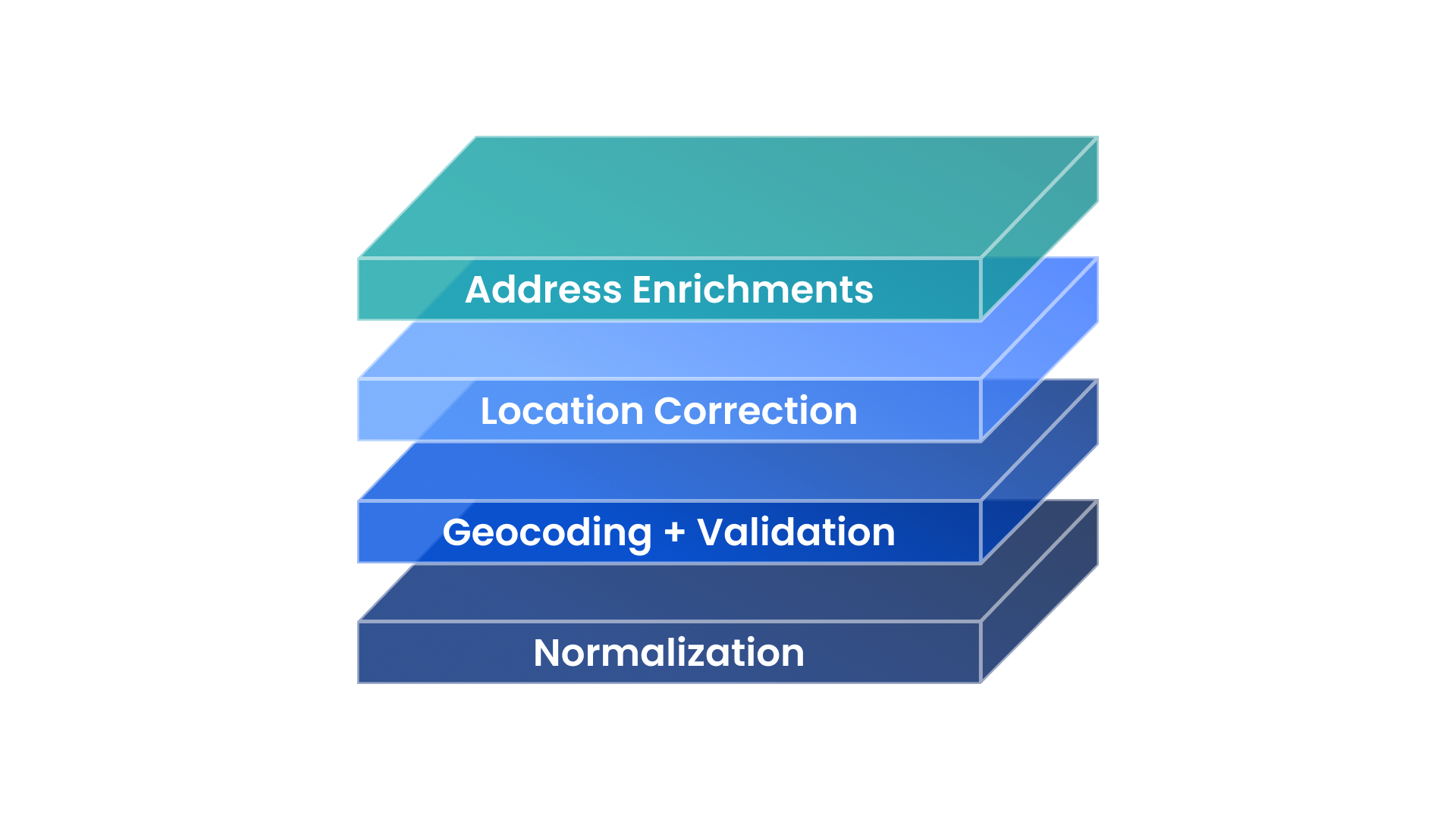
Between input and output, the engine runs four steps, each solving one problem:
- Normalization: applies country-specific rule sets to fix formatting errors and prepare the unstructured input for geocoding.
- Geocoding & validation: compares results across multiple geocoders to ensure the most accurate and contextually relevant result.
- Location correction: refines coordinates with historical driver corrections to reflect real delivery points.
- Address enrichment: adds last-meter details such as entrances, parking, handover locations, and historical driver notations. See Integration Options for where this layer is available.
- Standardized address output: cleaned, ready-to-use strings for labels and manifests.
- Granular address components: addresses split into distinct fields (street, locality, postal code) for database integration.
- Driver-verified coordinates: historical driver data pinpoints the actual delivery location, not just the building.
- Smart confidence scoring: accuracy scores let systems gauge how close a result is to the real-world point. See Geocoding Accuracy Levels.
- Last-meter locations: specific coordinates for parking, entrances, and handover, available when Better Places is used within the Bettermile suite.
Built for: geocoding address inputs across the supply chain, from first-mile pickup to last-mile delivery.
Not for: checking whether an address exists. Better Places resolves every input to the closest real-world location. For validity checks, use a dedicated address-verification tool.
Also note: only forward geocoding (address to coordinates) is supported. Reverse geocoding is not.
- Required: the address input must include the country. Any other details improve accuracy.
- Recommended: exclude personal information (names, phone numbers, emails) for GDPR. If included, the system removes it during normalization and does not store it.